Casa Pescara
Parquet · 3 min
Wide-plank wood flooring in Pescara: choosing a format
Review plank width, board lengths, visual grade, delivery access and transitions before you order.
Draw the rows and end joints on the plan
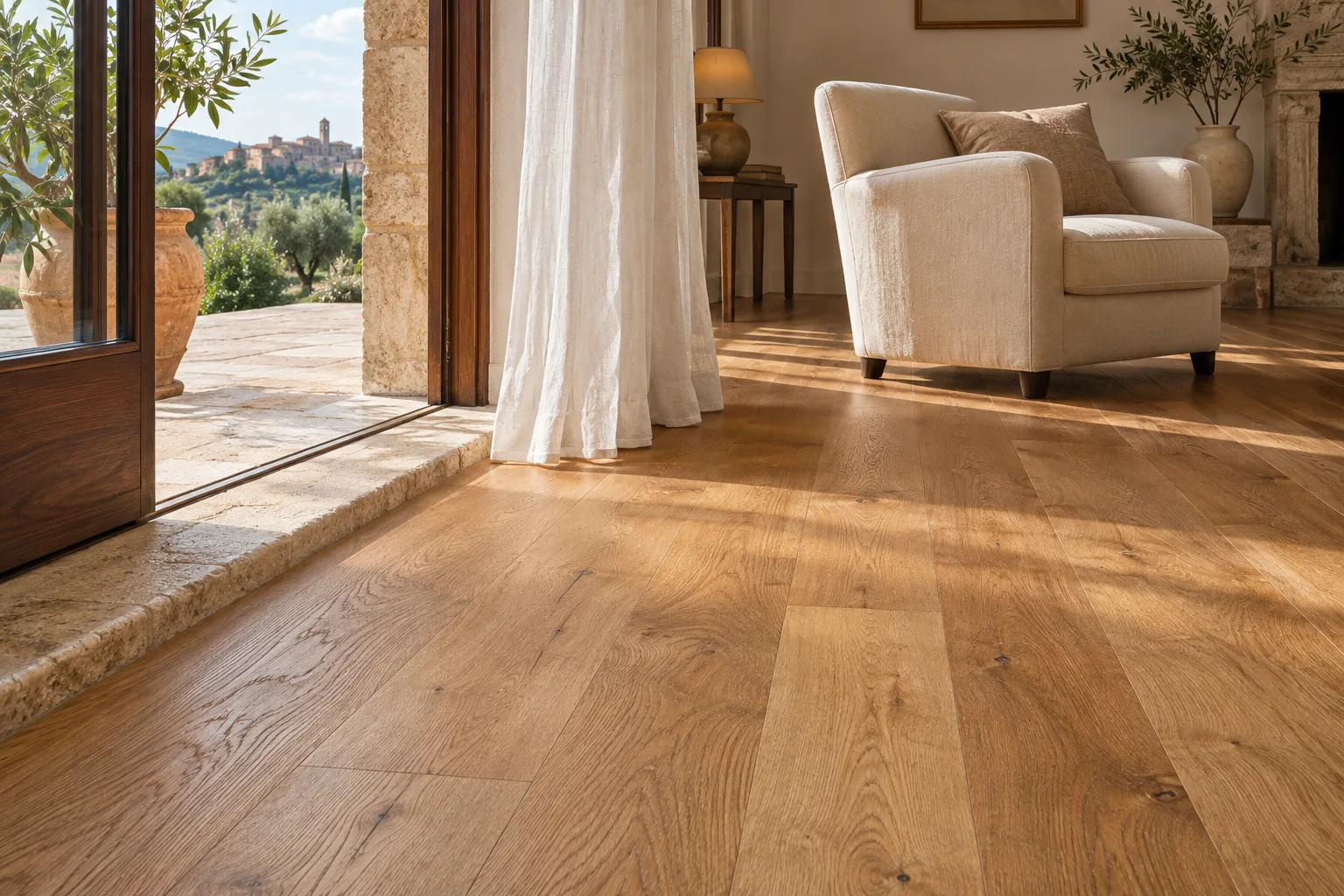
A wide plank should be assessed by the way it repeats across the room. Take a measured plan and overlay a series of lines spaced to match the board width. See how many rows fit through the narrowest section and where the edge cuts land. Check the pattern where a hall opens into a wider room. If the product comes in mixed lengths, ask how those lengths are distributed and how the end joints are staggered under the fitting instructions. A showroom photograph can feature boards much longer than those in the actual pack. A paper trial gives you something to ask about before you settle on an orientation.
Compare samples that reflect the whole batch
Look at several boards together to see the range of knots, colours and grain. A wide board can carry a figure that never appears on a small swatch. Ask which characteristics are allowed in the quoted grade and what variation the supplier expects across the delivery. If the edges are bevelled, see how clearly each joint shows under light from the side. In a Pescara flat, try the samples where daylight will reach them and then look from the door. Note which finish the quote refers to. A photograph in your own room helps you remember the comparison, especially as the light changes or the furniture moves.
Check suitability for the room and substrate
The installation system needs to allow the proposed board format on your subfloor. Have flatness, surface condition, moisture and any radiant heating checked. A wide plank is part of a system that includes its construction, thickness and method of fixing. A board that looks right in the showroom still needs to be checked against those conditions. Ask how timber movement will be accommodated and what spaces are required around walls, fixed objects and doorways. For a room with a large window, explain its orientation and indoor conditions to the person assessing the job. Keep the technical sheets for both options available while you compare them.
Check delivery with the packaging in mind
Find out how long the packs are before booking delivery. Measure the entrance, stairs, landing, lift and any tight corner between the building door and the room. Consider whether a pack can be tipped or turned without striking the walls or door frames. Ask who will carry the packs upstairs and where they can be stored under the manufacturer’s instructions. On the delivery day, shared routes may be busy or affected by other work. Agree access, unloading and protection with whoever coordinates the transport. If access is an issue, see whether another length mix would let you use the width you want.
Check cuts and quantities against a layout drawing
Before ordering, ask for a layout showing the direction, perimeter cuts and transitions. Find the boards that meet a threshold or run into a recess. Using long pieces in small spaces can create offcuts that need to be included in the quantity calculation. Clarify how the fitter counts usable offcuts and which leftovers you can keep for a later repair. Check that the quote records the format, range, finish and quantities. Keep a copy of the agreed drawing too. It can explain why an end joint falls where it does and how a future repair might be made without disrupting the pattern.
How we prepare the guides: sources and illustrative scenarios